Primary level health facilities
Every year, millions of sick children are seen at first-level health facilities. Due to limited human capacity in low- and middle-income countries, and to minimal or non-existent diagnostic supports such as radiology and laboratory services, many children may be inadequately assessed and treated. IMCI was developed to allow high-quality treatment with limited resources.
The IMCI case management process follows these steps:
- Assess the child’s illness.
- Classify the illness based on signs.
- Identify treatment.
- Treat the child.
- Counsel the caretaker.
- Provide follow-up care.
Related publications

This chart booklet belongs to a set of distance learning course on integrated management of childhood illness.
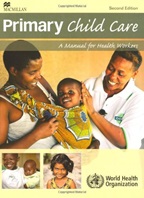
Primary Child Care: A manual for health workers
Primary Child Care: A manual for health workers has been written for health workers who provide primary care of infants and children, either during...
Training material
Management of the sick young infant age up to 2 months: IMNCI training course - Participant manual
These training materials are for training of health workers on the updated management guidelines for managing sick young infant (SYI) age 0 to 59 days....
Management of the sick young infant age up to 2 months: IMNCI training course - Facilitator guide
This module describes how to care for a young infant age 0 to 59 days. It describes how to use the chart booklet “Management of the Sick Young Infant...

The basis for the distance learning options (for both ICATT and paper-based distance learning IMCI) is that potentially IMCI could be scaled up in a short...
The IMCI model handbook provides a detailed explanation of the IMCI case management guidelines. It is organized into seven main parts: overview of the...
This learning package aims to help educators of healthcare providers become more effective teachers. The package is designed for teachers and tutors of...
The model chapter for textbooks was created to help authors and editors incorporate the content of IMCI into local and international textbooks and reference...
Guidelines for follow-up after training in the WHO/UNICEF Course of Integrated Management of Childhood...
The "Guidelines for Follow-up After Training" describe all of the tasks related to a follow-up visit, the second component of IMCI training. A follow-up...